
I don't know your district and I'd still bet money on this: somewhere between a dozen and a few hundred of your staff have a personal AI account they use for work. They set it up themselves. Nobody in IT knows about it.
It isn't a discipline problem. It's a latency problem. A teacher writing IEP goals at 9pm on a Sunday needs help now, not after the fall cabinet review. So she went to chatgpt.com, signed up with a personal email the same way she'd sign up for anything, it worked, and she told two people in her building on Monday.
Meanwhile the district is nine weeks into a four-vendor comparison trying to determine which AI tool is FERPA compliant.
Let me deal with that question first, because I've gotten it three times this month: none of them are. Nobody certifies software as FERPA compliant. There's no body that does it, no audit, no badge, no seal. FERPA is a law about what your district does with education records — the obligation sits with you, not with the software. What a vendor can actually give you is a data processing agreement, a willingness to be designated a school official under your direct control, and a commitment about what they do with whatever you type in the box.
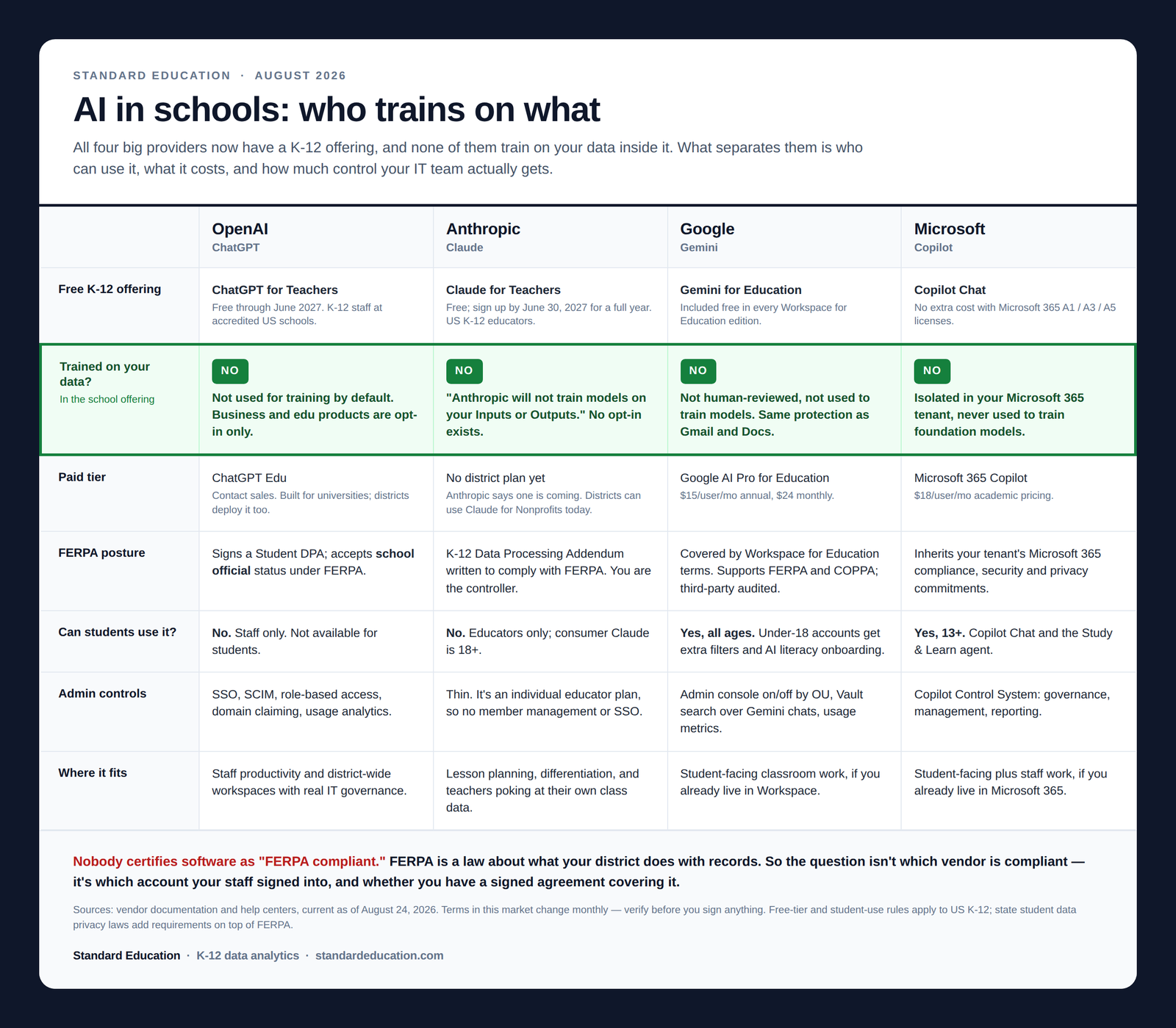
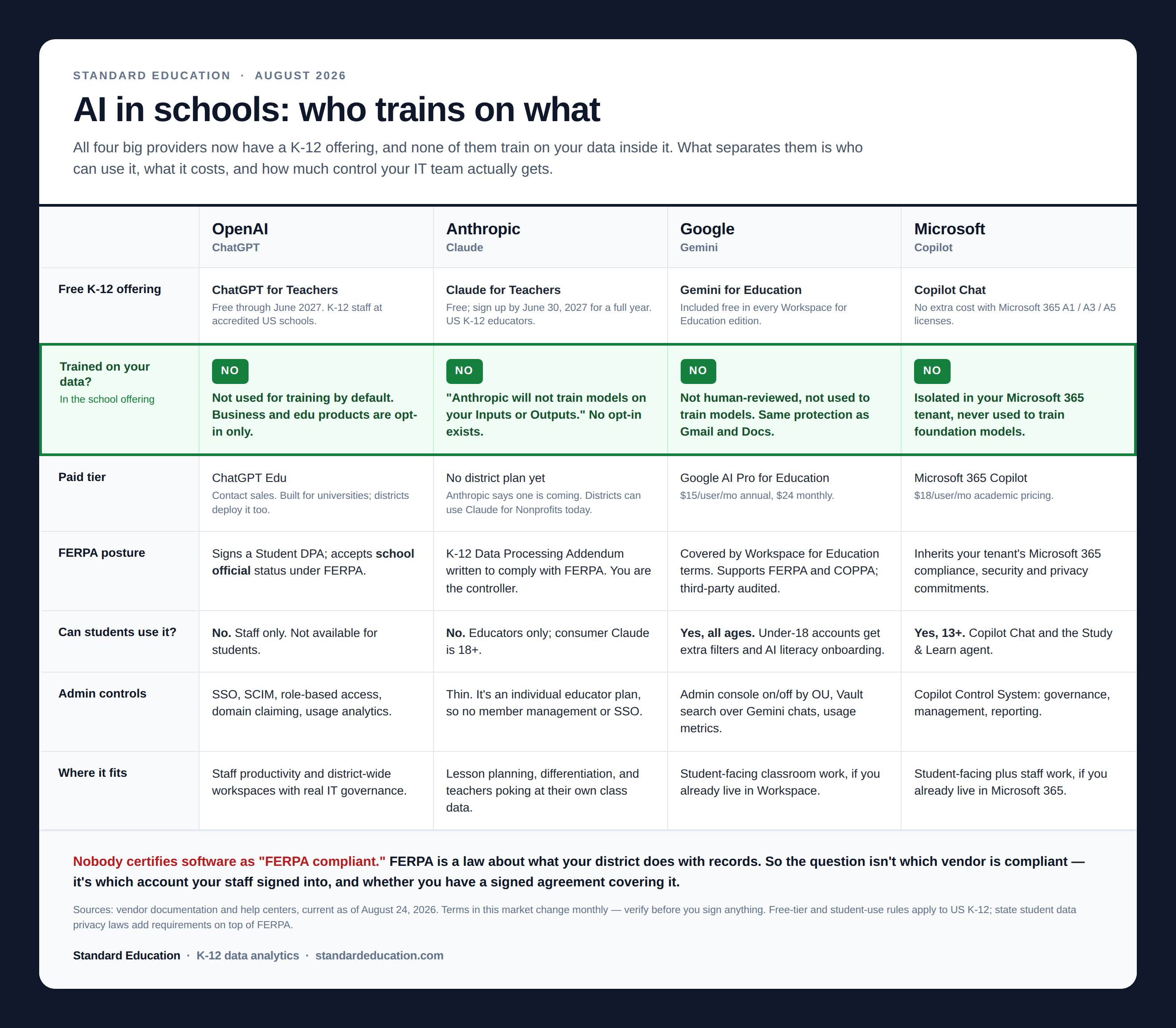
So I spent a few hours reading the actual terms from the four big providers and put the school offerings in one chart.
The school accounts are fine
This is the part that's genuinely better than it was 18 months ago. All four providers now have a real K-12 offering:
- ChatGPT for Teachers — free through June 2027 for staff at accredited US K-12 schools. Districts get SSO, SCIM, role-based access, domain claiming, usage analytics.
- Claude for Teachers — free, launched in July, sign up by June 30, 2027 for a full year. Lesson planning, differentiation, uploading your own class data to look for patterns. It's an individual educator plan, so the admin tooling is thin; Anthropic says a district offering is coming.
- Gemini for Education — included free in every Google Workspace for Education edition. Admin console controls per OU, Vault search over Gemini chats, usage metrics.
- Copilot Chat — no additional cost with Microsoft 365 A1, A3, or A5, governed through Microsoft's Copilot Control System.
And inside every one of those, the answer to "do you train on our data" is no. Not "no if you configure it correctly." No. OpenAI doesn't train on business or edu inputs by default. Anthropic says flatly it will not train on Claude for Teachers inputs or outputs and doesn't offer an opt-in. Google says Gemini for Education chats aren't human-reviewed or used to train models — same protection as Gmail and Docs. Microsoft keeps it in your tenant and never uses it for foundation model training.
Which means the vendor bake-off your team is agonizing over matters a lot less than it feels like it does. On the question everybody's actually worried about, all four give you the same answer.
The personal accounts are not
Every one of those commitments applies to the school account. Switch to a personal one and the terms flip:
- Consumer ChatGPT trains on your conversations unless you go turn it off.
- Consumer Copilot trains on conversation activity by default, with an opt-out a couple of clicks deep.
- A subset of consumer Gemini chats are reviewed by actual humans and kept up to three years — disconnected from the account, so deleting your activity doesn't pull them back.
- Claude Free, Pro, and Max is a privacy setting. Left on, your chats sit in de-identified training pipelines for up to five years.
Same company. Same model. Same blinking cursor. Nothing in the interface tells a teacher which side of that line she's standing on — the only difference is the email address she used on a Sunday night in October.
So when a district asks me about AI risk, the honest answer is that the risk usually isn't the tool the cabinet approved after four months of review. It's the shadow deployment that happened while the review was running.
Three things the chart doesn't tell you
1. Students are a separate question. The OpenAI and Anthropic free teacher plans are staff-only — not available for students at all — and consumer Claude is 18+. If you want a student-facing AI tool right now, that means Google (all ages, with extra filters and AI literacy onboarding under 18) or Microsoft (13+). Districts keep running four-way evaluations for a use case two of the four don't serve yet.
2. FERPA is the floor, not the ceiling. Your state almost certainly has its own student data privacy law with requirements FERPA doesn't have, and a lot of districts sign through the SDPC National DPA rather than a vendor's own paper. Check what your state adds before you decide a national agreement covers you.
3. These terms change monthly. Everything above is accurate as of August 24, 2026, pulled from vendor documentation. Two of those free tiers expire in mid-2027. One vendor's district plan doesn't exist yet. Treat the chart as a snapshot, not a reference.
Go find the accounts
If you're writing or rewriting an AI policy this fall, four questions get you further than a vendor comparison:
- Which accounts are our staff actually using? Not which ones we approved. Pull the SSO logs. Look at the browser telemetry. Ask the building principals who's using what. Find out.
- Do we have a signed agreement covering that account type? A DPA on ChatGPT Edu does nothing for a teacher on consumer ChatGPT.
- What student data is getting pasted in? A roster with names is a different conversation than "rewrite this parent email."
- Who owns the answer when it changes in November? Somebody has to own re-reading the terms. Name them.
And then do the unglamorous thing: get the free school-account version stood up and tell people it exists. Every one of these providers has a free tier for K-12 staff right now. The reason your teachers are on personal accounts is that nobody handed them a district one.
Where we sit
We build K-12 data analytics at Standard Education, so I'll be straight about our position: we're not an AI vendor and this isn't a setup for a product pitch. But we spend our days on the boring end of this — where student data comes from, who's allowed to see it, what the agreement says, what happens the night the sync runs.
What we keep seeing is districts stuck on a question that doesn't have an answer. "Is it FERPA compliant" doesn't. "Which account is my staff logged into, and do we have paper covering it" does.
One of those you can answer this week.
Sources
All figures and quotes verified August 24, 2026.
- OpenAI — ChatGPT for Teachers · Introducing ChatGPT Edu · How your data is used to improve model performance · Student Data Privacy Agreement
- Anthropic — Introducing Claude for Teachers · Claude for Teachers: your data and our terms · How personal data is used in model training
- Google — Gemini for Education · Privacy & Security FAQs · Gemini Apps privacy notice
- Microsoft — Microsoft 365 Copilot in Education · Microsoft Copilot privacy controls
- SDPC National Data Privacy Agreement